The Hidden Cost of Free Website Builders

The Promise: A Website in Minutes
If you have ever looked into building a website, you have probably seen advertisements promising that you can launch one in minutes. Drag-and-drop editors, beautiful templates, and “free” plans make the process look almost effortless.
Platforms such as Wix and Squarespace have made it possible for anyone to create a site without writing a single line of code. For many people that convenience is exactly what they need. A quick landing page or small personal website can often be online within a few hours.
But there is another side to that convenience that rarely appears in the marketing.
The Ownership Question
When you build a website using a hosted builder, you usually own your domain name and the content you put on the site. What you do not own is the platform that actually runs it.
The software, hosting environment, and editing tools all belong to the provider. You cannot access the underlying code, and you typically cannot move the site somewhere else in its original form.
That means your website lives entirely within that company’s ecosystem. If the platform changes its pricing, removes features, or alters how things work, your options are limited.
Most of the time this is not a problem. Until the day it is.
The Migration Problem
Many businesses first encounter this issue when they try to move their website somewhere else.
What seems like a simple change can quickly turn into a complete rebuild. Pages often have to be copied manually. Designs need to be recreated. Forms, blogs, and integrations must be set up again from scratch.
Traditional websites are usually made up of files and databases that can be exported and moved. Website builders tend to work differently. The design and content are deeply tied to the platform itself, which makes leaving far more difficult than starting.
The tool that made it easy to launch a site can quietly make it difficult to grow beyond it.
Performance Trade-offs
Website builders focus heavily on visual editing and flexibility. In order to support drag-and-drop design tools, they often include additional scripts and layout systems behind the scenes.
This extra complexity can lead to slower loading pages and heavier mobile performance. Visitors rarely think about what causes a slow website, but they definitely notice when one feels sluggish.
In a world where attention spans are short, even small delays can push people away from a site before they fully explore it.
The Upgrade Ladder
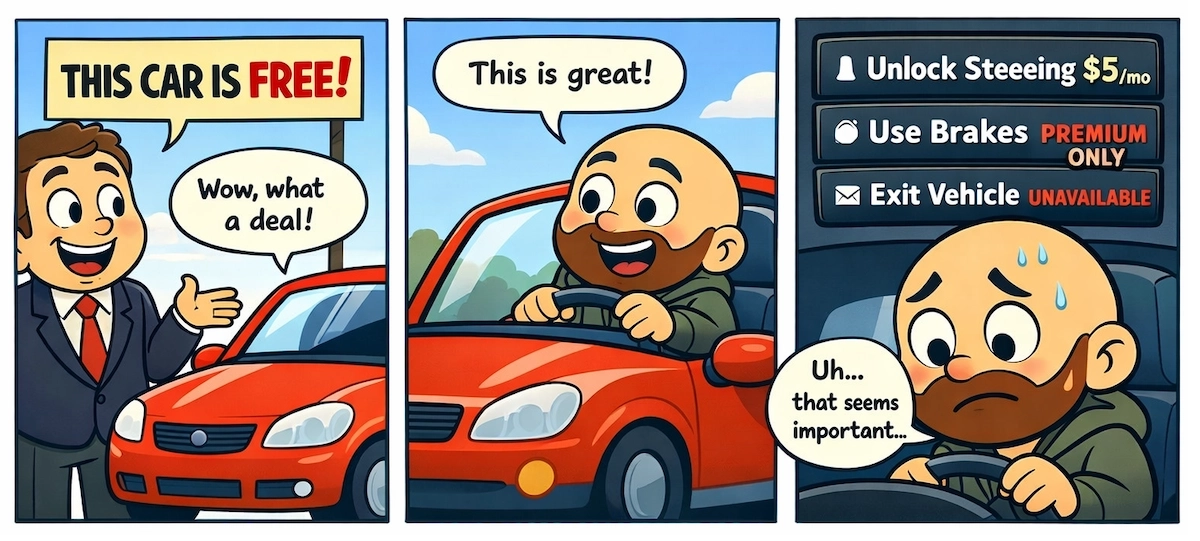
Another surprise comes from pricing. Many builders advertise free or very inexpensive starting plans, which can make them feel like a risk-free option.
However, those basic plans usually come with restrictions. Removing platform branding, connecting a custom domain, adding e-commerce features, or integrating analytics often requires paid upgrades.
Individually these upgrades may seem small, but over time the costs can grow. A website that started out as “free” slowly becomes another recurring monthly service.
When Website Builders Make Sense
None of this means website builders are bad tools. In fact, they solve a real and important problem.
They are excellent for personal projects, quick landing pages, and small businesses that simply need an online presence while testing an idea. For many people, getting something online quickly is far more important than long-term flexibility.
The issue is not the tools themselves. The issue is assuming they will always be the best tool as a website grows.
Final Thoughts
Website builders have made it easier than ever to launch a website. That accessibility has helped countless individuals and businesses establish an online presence.
At the same time, long-term websites often need flexibility, performance control, and the freedom to evolve over time. Those things can be harder to achieve when everything lives inside a closed platform.
The easiest path at the beginning can sometimes become the most restrictive later. A website is rarely a one-time project. It is something that grows and changes along with the people who rely on it.
When Every Website Looks the Same
Many websites are built from the same templates, creating a neighborhood of identical designs. A custom website helps your business stand out.
Every Project Starts Simple… Until It Doesn’t
Projects usually begin with a simple idea, but small, reasonable additions can quietly turn that simplicity into something much harder to manage. Without clear boundaries, scope grows on its own and even good ideas can make the work heavier than it needs to be.